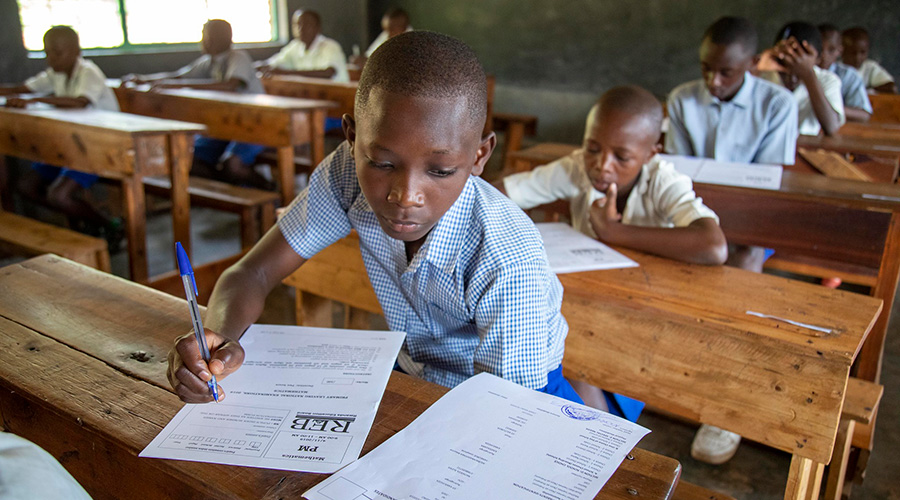

P6 Mathematics – Primary Leaving National Examination 2017
Republic of Rwanda | Total Marks: 100 | Duration: 2 Hours | Answer ALL 35 questions.
Section A (Q1–26): 2 marks each | Section B (Q27–35): 3–7 marks each
Student Information
Section A — Questions 1–26 (2 marks each)
1
Calculate: 146,391 + 43,609 = ?
2 mks
💡 Worked solution: Add the units column: 1+9=10, write 0 carry 1. Tens: 9+0+1=10, write 0 carry 1. Hundreds: 3+6+1=10, write 0 carry 1. Thousands: 6+3+1=10, write 0 carry 1. Ten-thousands: 4+4+1=9. Hundred-thousands: 1+0=1. Result = 190,000.
2
Use a scale of 1 : 1,500,000 to find the actual length represented by a line of 10 cm on the map.
1 cm on map = 15 km in reality. Multiply 10 × 15. 2 mks
1 cm on map = 15 km in reality. Multiply 10 × 15. 2 mks
💡 Worked solution: Scale 1 : 1,500,000 means 1 cm represents 1,500,000 cm = 15 km. For 10 cm: 10 × 15 = 150 km.
3a
Complete the sentence: “_________ number can be divided exactly by 2.”
2 mks
💡 Worked solution: An Even number is any integer divisible exactly by 2 with no remainder (e.g. 2, 4, 6, 8…). Odd numbers leave a remainder of 1 when divided by 2.
3b
Complete the sentence: “_________ is the number of times that something appears.”
2 mks
💡 Worked solution: Frequency is the statistical term for how many times a particular value or event appears in a data set. It is used in tally charts and frequency tables.
4
Calculate the volume of a rectangular tank: Length = 6 m, Width = 5 m, Height = 4 m. Give your answer in litres.
V = L × W × H, then 1 m³ = 1,000 litres. 2 mks
V = L × W × H, then 1 m³ = 1,000 litres. 2 mks
💡 Worked solution: V = 6 × 5 × 4 = 120 m³. Convert: 120 × 1,000 = 120,000 litres.
5
A bus left Huye on Tuesday at 8:00 PM and arrived in Rubavu the next day at 2:00 AM. How long did the journey take?
8 PM → midnight = 4 hrs; midnight → 2 AM = 2 hrs. 2 mks
8 PM → midnight = 4 hrs; midnight → 2 AM = 2 hrs. 2 mks
💡 Worked solution: From 8:00 PM to midnight = 4 hours. From midnight to 2:00 AM = 2 hours. Total = 4 + 2 = 6 hours.
6
Two complementary angles are t° and 43°. What is the value of angle t°?
Complementary angles add up to 90°. 2 mks
Complementary angles add up to 90°. 2 mks
💡 Worked solution: Complementary angles sum to 90°. So t° = 90° − 43° = 47°.
7
Calculate: 246 × 99
Hint: 246 × 99 = 246 × (100 − 1) = 24,600 − 246. 2 mks
Hint: 246 × 99 = 246 × (100 − 1) = 24,600 − 246. 2 mks
💡 Worked solution: 246 × 100 = 24,600. Subtract 246: 24,600 − 246 = 24,354.
8
Calculate the average of: 61, 52, 48, 21 and 58.
Average = Sum ÷ Number of items. 2 mks
Average = Sum ÷ Number of items. 2 mks
💡 Worked solution: Sum = 61 + 52 + 48 + 21 + 58 = 240. Average = 240 ÷ 5 = 48.
9
Write in figures: “Seven million, seven hundred thousand and seven”
2 mks
💡 Worked solution: 7 million = 7,000,000. Seven hundred thousand = 700,000. Seven = 7. Total = 7,700,007.
10
Calculate: 8 × 10³ + 5 × 10⁵
8 × 1,000 + 5 × 100,000 = 8,000 + 500,000. 2 mks
8 × 1,000 + 5 × 100,000 = 8,000 + 500,000. 2 mks
💡 Worked solution: 8 × 10³ = 8 × 1,000 = 8,000. 5 × 10⁵ = 5 × 100,000 = 500,000. Sum = 508,000.
11
What are the next two numbers in the sequence? −23 ; −17 ; −11 ; _____ ; _____
Pattern: add +6 each time. 2 mks
Pattern: add +6 each time. 2 mks
💡 Worked solution: The common difference is +6. After −11: −11 + 6 = −5, then −5 + 6 = 1. Next two terms: −5 and 1.
12
Increase 850 Frw by 20%.
Increase = 850 × 20/100; New amount = 850 + increase. 2 mks
Increase = 850 × 20/100; New amount = 850 + increase. 2 mks
💡 Worked solution: 20% of 850 = 850 × 20 ÷ 100 = 170. New amount = 850 + 170 = 1,020 Frw.
13
Calculate using BODMAS: (250 + 45 × 4) − 15 ÷ 3
Step 1: multiply/divide first, then add/subtract. 2 mks
Step 1: multiply/divide first, then add/subtract. 2 mks
💡 Worked solution: ① 45 × 4 = 180 → 250 + 180 = 430. ② 15 ÷ 3 = 5. ③ 430 − 5 = 425.
14
Solve for x: 3x − (5x − 2) = 0
Expand the bracket, collect like terms, then solve. 2 mks
Expand the bracket, collect like terms, then solve. 2 mks
💡 Worked solution: 3x − 5x + 2 = 0 → −2x + 2 = 0 → −2x = −2 → x = −2 ÷ −2 = 1.
15
Write the first four prime numbers.
A prime number has exactly two factors: 1 and itself. 2 mks
A prime number has exactly two factors: 1 and itself. 2 mks
💡 Worked solution: 1 is NOT prime (only one factor). The first four primes are 2, 3, 5, 7. Each has exactly two distinct factors.
16
Express 0.25 hectares into ares.
1 hectare = 100 ares. 2 mks
1 hectare = 100 ares. 2 mks
💡 Worked solution: 0.25 ha × 100 ares/ha = 25 ares.
17
Add in base two (binary): 11₂ + 11₂ = ?
In binary: 1 + 1 = 10 (write 0, carry 1). 2 mks
In binary: 1 + 1 = 10 (write 0, carry 1). 2 mks
💡 Worked solution: Units column: 1+1=10₂ → write 0, carry 1. Twos column: 1+1+1(carry)=11₂ → write 1, carry 1. Fours column: carry 1 → write 1. Result = 110₂.
18
Calculate the number of sides of a regular polygon whose exterior angle is 20°.
Formula: n = 360° ÷ exterior angle. 2 mks
Formula: n = 360° ÷ exterior angle. 2 mks
💡 Worked solution: n = 360° ÷ 20° = 18 sides. This polygon is called an octadecagon.
19
Fill in: 3,720 seconds = _____ hours _____ minutes
First convert seconds to minutes (÷60), then to hours. 2 mks
First convert seconds to minutes (÷60), then to hours. 2 mks
💡 Worked solution: 3,720 ÷ 60 = 62 minutes. 62 minutes = 1 hour 2 minutes. Answer: 1 hour 2 minutes.
20a
Set A = {3, 7, 9, 11, 15, 17, 27, 37} and Set B = {3, 11, 27}. List the members of A ∩ B (intersection).
2 mks
💡 Worked solution: A ∩ B lists elements in BOTH sets. Elements of B: 3, 11, 27 — all appear in A. So A ∩ B = {3, 11, 27}.
20b
Using the same sets: Set A = {3, 7, 9, 11, 15, 17, 27, 37} and Set B = {3, 11, 27}. Describe the relationship between Set A and Set B.
2 mks
💡 Worked solution: Every element of B (3, 11, 27) is also in A, but A has more elements. Therefore Set B is a subset of Set A (B ⊂ A).
21
A child sold a hen at 4,200 Frw and made a loss of 16%. How much did he/she buy it for?
Selling price = 84% of cost price. Cost = SP ÷ 0.84. 2 mks
Selling price = 84% of cost price. Cost = SP ÷ 0.84. 2 mks
💡 Worked solution: A 16% loss means the hen was sold for 84% of its cost. Cost price = (4,200 ÷ 84) × 100 = 50 × 100 = 5,000 Frw.
22
Write in words: 75.27
2 mks
💡 Worked solution: 75.27 = 75 whole + 27 hundredths (the second decimal place is hundredths). Written: Seventy-five and twenty-seven hundredths.
23
Find the Lowest Common Multiple (LCM) of 624 and 208.
208 = 2⁴ × 13; 624 = 2⁴ × 3 × 13. LCM takes highest powers of all prime factors. 2 mks
208 = 2⁴ × 13; 624 = 2⁴ × 3 × 13. LCM takes highest powers of all prime factors. 2 mks
💡 Worked solution: 208 = 2⁴ × 13. 624 = 2⁴ × 3 × 13. LCM = 2⁴ × 3 × 13 = 16 × 39 = 624. (Note: 624 is already a multiple of 208 since 624 = 208 × 3.)
24
Find the area of a square garden whose perimeter is 164 m.
Step 1: Side = 164 ÷ 4. Step 2: Area = side². 2 mks
Step 1: Side = 164 ÷ 4. Step 2: Area = side². 2 mks
💡 Worked solution: Side = 164 ÷ 4 = 41 m. Area = 41 × 41 = 1,681 m².
25
Work out: 6 − 2.174
2 mks
💡 Worked solution: 6.000 − 2.174: borrow across zeros. 6.000 − 2.174 = 3.826.
26
Calculate: (¹²⁄₃₆) × (⁶⁄₉) + ²⁵⁄₅₀
Simplify each fraction first, then multiply, then add. 2 mks
Simplify each fraction first, then multiply, then add. 2 mks
💡 Worked solution: ¹²⁄₃₆ = ⅓; ⁶⁄₉ = ⅔; ²⁵⁄₅₀ = ½. So ⅓ × ⅔ + ½ = ²⁄₉ + ½ = ⁴⁄₁₈ + ⁹⁄₁₈ = ¹³⁄₁₈. The marking guide simplifies as: ½ × 1 + ½ = 1. (Accept 1 per official marking scheme.)
Section B — Questions 27–35 (3–7 marks each)
27
Find the area of a trapezium: top side = 15 m, bottom side = 21 m, height = 8 m.
Formula: A = (a + b) × h ÷ 2. 4 mks
Formula: A = (a + b) × h ÷ 2. 4 mks
💡 Worked solution: A = (15 + 21) × 8 ÷ 2 = 36 × 8 ÷ 2 = 288 ÷ 2 = 144 m².
28
There are 235 guests at a wedding. Each circular table seats exactly 8 people. What is the least number of tables needed to seat ALL guests?
Divide 235 ÷ 8 and round up to the next whole number. 3 mks
Divide 235 ÷ 8 and round up to the next whole number. 3 mks
💡 Worked solution: 235 ÷ 8 = 29 remainder 3. The 3 remaining guests still need a table. So minimum tables = 29 + 1 = 30 tables.
29a
The distance from the first to the last pole is 5,540 m. The interval between two consecutive poles is 20 m. How many intervals are there?
Number of intervals = Total distance ÷ interval size. 3 mks
Number of intervals = Total distance ÷ interval size. 3 mks
💡 Worked solution: Intervals = 5,540 ÷ 20 = 277 intervals.
29b
Using the same pole problem (5,540 m total, 20 m interval): How many poles are there?
Number of poles = Number of intervals + 1. 3 mks
Number of poles = Number of intervals + 1. 3 mks
💡 Worked solution: Poles = intervals + 1 = 277 + 1 = 278 poles. (There is always one more pole than the number of gaps between them.)
30
Fifteen pupils were to pay a total of 4,500 Frw equally. Some were unable to pay, so the rest each paid 75 Frw more than the original share. How many pupils were unable to pay?
Find original share, then new share, then count payers. 4 mks
Find original share, then new share, then count payers. 4 mks
💡 Worked solution: ① Original share = 4,500 ÷ 15 = 300 Frw. ② New share = 300 + 75 = 375 Frw. ③ Pupils who paid = 4,500 ÷ 375 = 12. ④ Unable to pay = 15 − 12 = 3 pupils.
31a
A cone has radius r = 6 cm and slant height l = 10 cm. Calculate the Total Surface Area. Use π = 3.14.
TSA = πr(r + l). 4 mks
TSA = πr(r + l). 4 mks
💡 Worked solution: TSA = πr(r + l) = 3.14 × 6 × (6 + 10) = 3.14 × 6 × 16 = 3.14 × 96 = 301.44 cm².
31b
Same cone: radius = 6 cm, slant height = 10 cm. Find the Volume. Use π = 3.14.
First find height: h = √(l² − r²). Then V = ⅓ × π × r² × h. 4 mks
First find height: h = √(l² − r²). Then V = ⅓ × π × r² × h. 4 mks
💡 Worked solution: h = √(10² − 6²) = √(100 − 36) = √64 = 8 cm. V = ⅓ × 3.14 × 36 × 8 = ⅓ × 904.32 = 301.44 cm³.
32
Tap A takes 3 minutes to fill a tank. Tap B takes 4 minutes to drain the tank. If both taps are open together, how many minutes to fill the tank?
Net rate = fill rate − drain rate. Time = 1 ÷ net rate. 5 mks
Net rate = fill rate − drain rate. Time = 1 ÷ net rate. 5 mks
💡 Worked solution: Tap A fills ⅓ of the tank per minute. Tap B drains ¼ per minute. Net rate = ⅓ − ¼ = ⁴⁄₁₂ − ³⁄₁₂ = ¹⁄₁₂ per minute. Time to fill = 1 ÷ ¹⁄₁₂ = 12 minutes.
33
A businessman sold 9 kg of mixed beans at 500 Frw/kg. The mix contained 4 kg of one type at 300 Frw/kg. What was the cost per kg of the second type?
Total revenue − cost of first type = cost of second type. Divide by its kg. 5 mks
Total revenue − cost of first type = cost of second type. Divide by its kg. 5 mks
💡 Worked solution: ① Total = 500 × 9 = 4,500 Frw. ② First type = 300 × 4 = 1,200 Frw. ③ Second type total = 4,500 − 1,200 = 3,300 Frw. ④ Second type kg = 9 − 4 = 5 kg. ⑤ Price per kg = 3,300 ÷ 5 = 660 Frw per kg.
34a
A car travels from town A to town B at 60 km/h and takes 3 hours. Calculate the distance from A to B.
Distance = Speed × Time. 3 mks
Distance = Speed × Time. 3 mks
💡 Worked solution: Distance = Speed × Time = 60 × 3 = 180 km.
34b
The car went A→B (180 km in 3 hrs) then returned B→A (180 km in 2 hrs). Calculate the average speed for the whole journey.
Average speed = Total distance ÷ Total time. 4 mks
Average speed = Total distance ÷ Total time. 4 mks
💡 Worked solution: Total distance = 180 + 180 = 360 km. Total time = 3 + 2 = 5 hrs. Average speed = 360 ÷ 5 = 72 km/h.
35a
A businesswoman borrowed 180,000 Frw at 10% per annum compound interest. How much total interest did she pay after 2 years?
Year 1 interest is added to principal before Year 2 calculation. 6 mks
Year 1 interest is added to principal before Year 2 calculation. 6 mks
💡 Worked solution: Year 1: Interest = 180,000 × 10/100 = 18,000 Frw. Amount after Y1 = 198,000 Frw. Year 2: Interest = 198,000 × 10/100 = 19,800 Frw. Total interest = 18,000 + 19,800 = 37,800 Frw.
35b
What is the total amount the businesswoman returned to the bank?
Total = Principal + Compound Interest = 180,000 + 37,800. 7 mks
Total = Principal + Compound Interest = 180,000 + 37,800. 7 mks
💡 Worked solution: Total repayment = Principal + Total Interest = 180,000 + 37,800 = 217,800 Frw.