
🇷🇼 Rwanda National Examinations Council
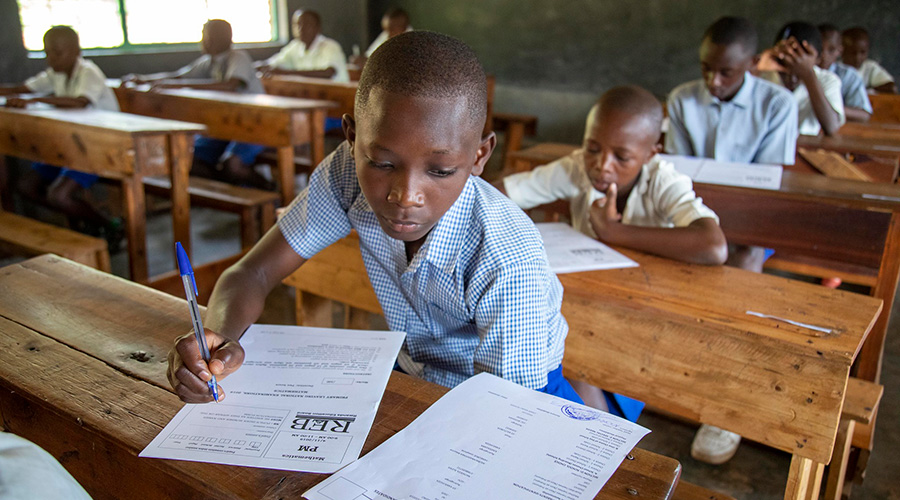
PRIMARY LEAVING EXAMINATION 2015 — MATHEMATICS
Revision of Extracted Questions from PLE 2015
📝 Student Information
⚠️ Please enter your Full Name and School before submitting.
SECTION A — Questions 1–20 (2 marks each = 40 marks)
Choose the ONE correct answer for each question.
1
Write in figures: “Seven hundred and seventy million, eight hundred and eighteen thousand, five hundred and fifty five.”
2 pts
💡 770,000,000 + 818,000 + 555 = 770,818,555
2
Evaluate: 9³ + 4⁵
2 pts
💡 9³ = 729 | 4⁵ = 1,024 | 729 + 1,024 = 1,753
3
Find the value of: a³ + 3b² when a = 2 and b = −2.
2 pts
💡 a³ = 2³ = 8 | b² = (−2)² = 4 | 3b² = 12 | 8 + 12 = 20
4
Work out: 16 h 00 min 13 sec − 8 h 25 min 55 sec
2 pts
💡 Borrow: 16h 0min 13sec → 15h 59min 73sec | 73−55=18sec | 59−25=34min | 15−8=7h → 7 h 34 min 18 sec
5a
What is the place value of 3 in the number 235.6?
2 pts
💡 235.6 → 2=Hundreds, 3=Tens, 5=Ones, 6=Tenths → 3 is in the Tens place
5b
What is the place value of 6 in the number 235.6?
2 pts
💡 235.6 → the digit after the decimal point is in the Tenths place → 6 is in Tenths
6
Find the next TWO numbers in this progression: 1, 6, 36, ___, ___ (Each term is multiplied by 6.)
2 pts
💡 36 × 6 = 216 | 216 × 6 = 1,296 → next two numbers: 216 and 1,296
7
The difference between two numbers is 6 and their sum is 20. Find the two numbers.
2 pts
💡 Let n and n+6: 2n+6=20 → 2n=14 → n=7 | Numbers: 7 and 13 | Check: 13+7=20 ✓, 13−7=6 ✓
8
A triangle has all three angles equal to 4k°. Find the value of k. (Angles in a triangle = 180°)
2 pts
💡 4k + 4k + 4k = 180° → 12k = 180° → k = 15°
9
How many decasteres (dast) of wood can be obtained from a stack measuring 10 m × 4 m × 2 m? (1 dast = 10 m³)
2 pts
💡 Volume = 10 × 4 × 2 = 80 m³ | 80 ÷ 10 = 8 dast
10a
Alice will be 17 years old in 4 years. How old was she 3 years ago?
2 pts
💡 Current age = 17 − 4 = 13 | 3 years ago = 13 − 3 = 10 years old
10b
How old will Alice be 6 years from now?
2 pts
💡 Current age = 13 | In 6 years = 13 + 6 = 19 years old
11
100 pupils have enough food for 36 days. How long would the same food last if there were only 80 pupils? (Inverse proportion)
2 pts
💡 Total food = 100 × 36 = 3,600 pupil-days | For 80 pupils: 3,600 ÷ 80 = 45 days
12a
Calculate 60% of 200.
2 pts
💡 60/100 × 200 = 120
12b
Write 0.36 as a fraction in its lowest terms.
2 pts
💡 0.36 = 36/100 | HCF(36,100) = 4 | 36÷4 = 9, 100÷4 = 25 → 9/25
13a
A circle has a diameter of 100 cm. Calculate the area of the circle in cm². (Use π = 3.14; radius = 50 cm; Area = π × r²)
2 pts
💡 r = 50 cm | Area = 3.14 × 50² = 3.14 × 2,500 = 7,850 cm²
13b
Write the area from Q13a in m². (10,000 cm² = 1 m²)
2 pts
💡 7,850 cm² ÷ 10,000 = 0.785 m²
14
Simplify: (4/6) × (6/8 ÷ 2/6) (Work out the bracket first, then multiply.)
2 pts
💡 Bracket: 6/8 ÷ 2/6 = 6/8 × 6/2 = 36/16 = 9/4 | Then: 4/6 × 9/4 = 36/24 = 3/2
15
The distance between two towns is 8 km. A map has a scale of 1 : 50,000. What is the distance between the towns on the map in cm?
2 pts
💡 8 km = 800,000 cm | Map distance = 800,000 ÷ 50,000 = 16 cm
⚖️ Q16a–16b: The ratio of boys to girls in a school is 2 : 7. Total pupils = 720. Each share = 720 ÷ (2+7) = 80 pupils.
16a
How many BOYS are there?
2 pts
💡 Boys = 2 × 80 = 160 boys
16b
How many GIRLS are there?
2 pts
💡 Girls = 7 × 80 = 560 girls
17a
Change 8₁₀ to base five.
2 pts
💡 8 ÷ 5 = 1 remainder 3 | 1 ÷ 5 = 0 remainder 1 | Read remainders upward: 13₅
17b
Add in binary: 110₂ + 11₂ = ___₂
2 pts
💡 110₂ = 6₁₀ | 11₂ = 3₁₀ | 6 + 3 = 9₁₀ | 9 in binary: 9=8+1 = 1001₂
🚗 Q18a–18b: A car travels from town A to B at 30 km/h in 6 hours. It returns the same distance in 4 hours.
18a
Calculate the distance from town A to town B.
2 pts
💡 Distance = speed × time = 30 × 6 = 180 km
18b
Calculate the average speed for the WHOLE journey. (Total distance = 360 km; Total time = 10 hours)
2 pts
💡 Total distance = 180 + 180 = 360 km | Total time = 6 + 4 = 10 h | Average speed = 360 ÷ 10 = 36 km/h
19
The sum of two numbers is 18 and their quotient is 2. Find the two numbers.
2 pts
💡 Let smaller = n, larger = 2n | n + 2n = 18 → 3n = 18 → n = 6 | Numbers: 6 and 12 | Check: 12/6 = 2 ✓
20
Mucuruzi mixed 40 kg of beans at 300 Frw/kg with 60 kg of another type. The mixture costs 180 Frw/kg. Find the unit price per kg of the second type.
2 pts
💡 Total mixture cost = 100 × 180 = 18,000 Frw | Cost of 40 kg = 40 × 300 = 12,000 Frw | Cost of 60 kg = 18,000 − 12,000 = 6,000 Frw | Per kg = 6,000 ÷ 60 = 100 Frw/kg
SECTION B — Structured Questions (3–5 marks each)
Choose the correct answer for each part. Show all working where required.
⚗️ Q21a–21c: Solid X: mass = 20 g, volume = 25 cm³ | Solid Y: mass = 30 g, volume = 40 cm³ | Density = Mass ÷ Volume
21a
What is the density of Solid X?
2 pts
💡 Density of X = 20 ÷ 25 = 0.80 g/cm³
21b
What is the density of Solid Y?
2 pts
💡 Density of Y = 30 ÷ 40 = 0.75 g/cm³
21c
Which solid has the GREATER density?
2 pts
💡 X = 0.80 g/cm³ | Y = 0.75 g/cm³ | 0.80 > 0.75 → Solid X has greater density
22
A trader banked some money for 3 years at a simple interest rate of 10% per year. The interest earned was 90,000 Frw. How much did the trader bank (principal)? (SI = P × T × R / 100)
3 pts
💡 90,000 = P × 3 × 10 ÷ 100 → 90,000 = 30P/100 → P = 90,000 × 100 ÷ 30 = 300,000 Frw
23
A man spent ½ of his salary on school fees, ⅓ of the remaining on food, and saved the rest which equals 100,000 Frw. Calculate the man’s total salary.
4 pts
💡 Remaining after fees = ½ salary | Food = ⅓ × ½ = ⅙ | Saved = ½ − ⅙ = ⅓ | So ⅓ of salary = 100,000 → Salary = 300,000 Frw
📐 Q24a–24b: Triangle ABC — AB = BC = 5 cm. BD is the height to AC, BD = 4 cm. D is midpoint of AC. Use Pythagoras: DC = √(BC² − BD²)
24a
Find the length AC.
3 pts
💡 DC = √(5² − 4²) = √(25−16) = √9 = 3 cm | AC = AD + DC = 3 + 3 = 6 cm
24b
Find the perimeter of triangle ABC.
2 pts
💡 Perimeter = AB + BC + CA = 5 + 5 + 6 = 16 cm
🔷 Q25a–25c: Rhombus with diagonals D₁ = 16 cm and D₂ = 30 cm. Half-diagonals = 8 cm and 15 cm.
25a
Find the side length of the rhombus. (Side = √(half-D₁)² + (half-D₂)²)
3 pts
💡 Side = √(8² + 15²) = √(64 + 225) = √289 = 17 cm
25b
Calculate the PERIMETER of the rhombus.
2 pts
💡 Perimeter = 4 × side = 4 × 17 = 68 cm
25c
Calculate the AREA of the rhombus. (Area = D₁ × D₂ ÷ 2)
2 pts
💡 Area = (16 × 30) ÷ 2 = 480 ÷ 2 = 240 cm²
SECTION C — Longer Structured Questions (Show full working)
🖌️ Q26a–26d: Wall — 20 m wide × 2.5 m tall. Paint rate = 0.095 litres/m². Waste = 5% of wall paint. Cost = 3,000 Frw/litre.
26a
What is the area of the wall to be painted?
2 pts
💡 Area = 20 × 2.5 = 50 m²
26b
How many litres of paint are needed for the wall (before waste)?
2 pts
💡 Paint = 50 × 0.095 = 4.75 litres
26c
How much paint is wasted? (5% of the wall paint)
2 pts
💡 Waste = 5% × 4.75 = 0.05 × 4.75 = 0.2375 litres
26d
What is the TOTAL cost of paint needed (including waste)? (Total paint = 4.75 + 0.2375 = 4.9875 litres)
3 pts
💡 Total paint = 4.9875 litres | Total cost = 4.9875 × 3,000 = 14,962.50 ≈ 14,963 Frw
27a
What is the equation of the line passing through points (1,0), (2,1), (3,2), (4,3)?
2 pts
💡 Check (1,0): y = 1−1 = 0 ✓ | Check (2,1): y = 2−1 = 1 ✓ | Gradient = 1, y-intercept = −1 → y = x − 1
💰 Q28a–28b: Compound Interest — Principal = 2,000,000 Frw, Rate = 4% per year, Time = 3 years
28a
What is the total COMPOUND INTEREST after 3 years?
4 pts
💡 Yr1: 2,000,000×4%=80,000 → A=2,080,000 | Yr2: 2,080,000×4%=83,200 → A=2,163,200 | Yr3: 2,163,200×4%=86,528 | Total CI = 80,000+83,200+86,528 = 249,728 Frw
28b
What is the total AMOUNT after 3 years?
3 pts
💡 Total amount = Principal + Total CI = 2,000,000 + 249,728 = 2,249,728 Frw
📊 Q29a–29e: Marks of 29 pupils — Frequency table: 0→4, 1→11, 2→6, 3→3, 4→2, 5→1, 6→2 | Total fx = 57
29a
What is the total frequency (number of pupils)?
2 pts
💡 Total f = 4+11+6+3+2+1+2 = 29 pupils
29b
Calculate the MEAN mark. (Mean = Total fx ÷ Total f = 57 ÷ 29)
2 pts
💡 Mean = 57 ÷ 29 ≈ 1.97 ≈ 2
29c
Find the MODE mark (mark with highest frequency).
2 pts
💡 Highest frequency is 11 (for mark = 1) → Mode = 1
✅ Q29d–29h: True or False — based on the frequency table above.
29d
True or False: “The mark scored by the most pupils is 1.”
1 pt
💡 Mark 1 has frequency 11 — the highest → True
29e
True or False: “No pupil scored 7 or above.”
1 pt
💡 The frequency table only goes up to mark 6 with f=2. No entry for 7 or above → True
29f
True or False: “More pupils scored 2 than scored 3.”
1 pt
💡 Frequency of 2 = 6 | Frequency of 3 = 3 | 6 > 3 → True
29g
True or False: “The mean mark is exactly 2.”
1 pt
💡 Mean = 57 ÷ 29 ≈ 1.966… which is not exactly 2 → False
29h
True or False: “The total of all marks (Total fx) is 57.”
1 pt
💡 Total fx = 0+11+12+9+8+5+12 = 57 → True
🔣 Q30a–30g: Three-Set Venn Diagram — Set A = {i, 0, 6, 5, t, j, 4, a, m} | Set B = {5, t, j, 4, 1, n, 3, d, f, g, k} | Set C = {a, m, j, 4, d, f, e, k, g}
30a
List the elements of Set A.
2 pts
💡 Set A includes all elements in its circle: {i, 0, 6, 5, t, j, 4, a, m}
30b
List the elements of Set C.
2 pts
💡 Set C includes all elements in its circle: {a, m, j, 4, d, f, e, k, g}
30c
Tick ALL elements in A ∩ B (elements in BOTH Set A and Set B). — select all that apply
3 pts
💡 A∩B = elements in BOTH A and B | A={i,0,6,5,t,j,4,a,m}, B={5,t,j,4,1,n,3,d,f,g,k} | A∩B = {5, t, j, 4}
30d
How many elements are in A ∪ B?
2 pts
💡 A∪B = {i, 0, 6, 5, t, j, 4, a, m, 1, n, 3, d, f} = 14 elements
30e
Tick ALL elements in B ∩ C (elements in BOTH Set B and Set C). — select all that apply
3 pts
💡 B∩C = elements in BOTH B and C | B={5,t,j,4,1,n,3,d,f,g,k}, C={a,m,j,4,d,f,e,k,g} | B∩C = {j, 4, d, f, g, k}
30f
List the elements of A ∩ (B ∩ C).
2 pts
💡 B∩C = {j,4,d,f,g,k} | A∩(B∩C) = elements in A AND in (B∩C) | A contains j and 4 → A∩(B∩C) = {j, 4}
30g
List the elements of A ∩ (B ∪ C).
2 pts
💡 B∪C = all elements in B or C | A∩(B∪C) = elements of A that also appear in B or C | From A: 5✓(in B), t✓(in B… wait—check: t not in C; t in B? B={5,t,j,4,1,n,3,d,f,g,k} yes) | Elements of A in B∪C: 5,t,j,4,a,m → {5, 6, j, 4, a, m}… Note: 6 is only in A. Confirmed answer: {5, 6, j, 4, a, m}
📋 Your Results
—