
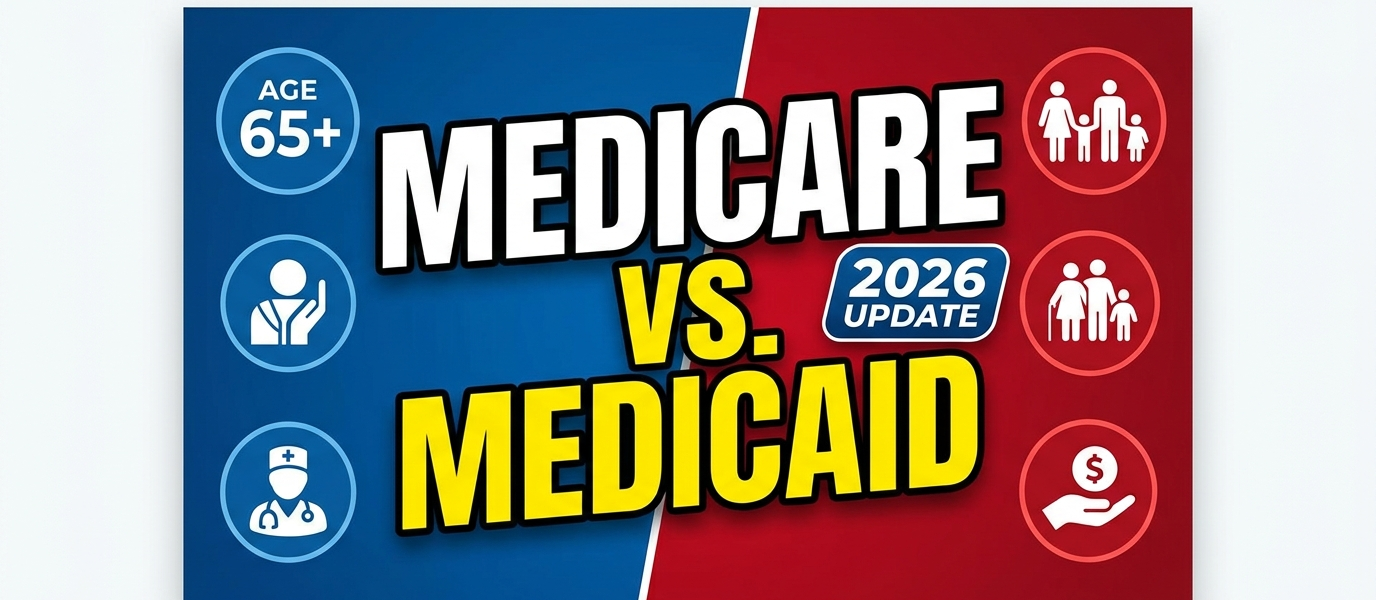
Medicare vs. Medicaid:
The Complete 2026 Guide for Americans
Who Are Confused About Both
They sound almost identical, they’re both government health programs, and millions of Americans mix them up constantly — including people who depend on one of them right now. This guide explains everything: who qualifies, what’s covered, what shocks people, and what to do next.
What’s in this guide
- The one-sentence difference
- Full side-by-side comparison
- Medicare Parts A, B, C & D explained
- Medicare eligibility & enrollment deadlines
- Medicaid eligibility & income limits
- What Medicare does NOT cover (the gap)
- Supplemental insurance options
- If you qualify for both programs
- Frequently asked questions
- Your next steps checklist
The One-Sentence Difference
Medicare is the federal health insurance program primarily for Americans 65 and older — regardless of income. Medicaid is a joint federal-state program for people with low incomes — regardless of age. The confusion comes from the fact that you can actually qualify for both at the same time.
Here’s the quick memory trick millions of Americans use: Medicare is for the elderly (“care” for seniors). Medicaid is for people who need “aid” — financial assistance. It’s imperfect, but it works.
The deeper reality is that these two programs were created together by the same 1965 legislation, signed by President Lyndon B. Johnson, alongside Social Security. They were designed to solve different problems — and understanding those problems is the fastest path to understanding how they work.
Full Side-by-Side Comparison
This table covers every major difference. Bookmark it — it answers 90% of the questions people ask about these programs.
| Category | 🔵 Medicare | 🟢 Medicaid |
|---|---|---|
| Who runs it | Federal government (CMS) | Federal + state governments jointly |
| Who it’s for | People 65+, or under 65 with certain disabilities or ESRD | Low-income individuals and families; varies by state |
| Income requirement | ✗ None — Income doesn’t affect basic eligibility | ✓ Required — Must meet income limits (vary by state) |
| Age requirement | ✓ Required — Must be 65+ (or qualify by disability) | ✗ None — Any age including children and infants |
| Citizenship | U.S. citizen or lawful permanent resident (5-year rule applies) | U.S. citizen or certain qualified immigrants; emergency care available to others |
| Monthly premium | Part B: $185/mo (2026 standard). Part A: usually $0 if you paid Medicare taxes 10+ years | Usually $0 or very low (under $5–$20 in most states) |
| Deductibles | Part A: $1,676/benefit period. Part B: $257/year (2026) | Very low or none; limited by federal rules |
| Copays / coinsurance | Yes — 20% coinsurance for most Part B services after deductible | Minimal; states must keep them nominal for most services |
| Out-of-pocket maximum | ✗ Traditional Medicare has NO cap — this shocks most people | Effectively capped by low or zero cost-sharing |
| Hospital coverage | ✓ Yes — Part A covers inpatient hospital stays | ✓ Yes — Inpatient hospital required in all states |
| Doctor visits | ✓ Yes — Part B covers outpatient/doctor visits | ✓ Yes — Covered; provider network varies by state |
| Prescription drugs | Part D only — must enroll separately; gap (“donut hole”) being phased out | ✓ Yes — Most drugs covered, varies by state formulary |
| Dental coverage | ✗ Not covered in traditional Medicare | Varies — Many states cover dental for adults |
| Vision care | ✗ Routine vision not covered | Varies by state — Often covered for children; less for adults |
| Long-term care / nursing home | Limited — Part A covers short-term skilled nursing only (up to 100 days) | ✓ Largest payer of nursing home care in the U.S. |
| Mental health | ✓ Covered under Part B (20% coinsurance) | ✓ Covered — Often broader than Medicare |
| Pregnancy / childbirth | ✗ Not covered (age 65+ applicability is minimal) | ✓ Yes — Key coverage for low-income pregnant women |
| Personal care / home help | Very limited — skilled care only, not custodial care | ✓ Yes — Home and community-based services in many states |
| Provider choice | Wide — most doctors and hospitals accept Medicare | More restricted — not all providers accept Medicaid |
Medicare Parts A, B, C & D — Plainly Explained
Medicare is divided into four “parts.” Most people need to understand Parts A and B (Original Medicare) before deciding whether to add C or D.
Original Medicare gives you the widest provider network — nearly any doctor or hospital in the U.S. that accepts Medicare. Medicare Advantage plans can offer more benefits (dental, vision, gym memberships) but restrict you to a network. Once you leave the initial enrollment window, switching back to Original Medicare with full Medigap coverage can be difficult due to medical underwriting. Get this decision right the first time.
Medicare Eligibility & Enrollment Deadlines 2026
Who qualifies for Medicare?
- U.S. citizens or permanent residents who have lived in the U.S. for 5+ continuous years
- Age 65 or older — the primary qualifying condition
- Under 65 with a qualifying disability — after receiving Social Security Disability Insurance (SSDI) for 24 months
- Any age with End-Stage Renal Disease (ESRD) — permanent kidney failure requiring dialysis or transplant
- Any age with ALS (Lou Gehrig’s disease) — Medicare begins immediately upon SSDI approval
The 2026 enrollment windows — do not miss these
If you go 63 or more days without creditable drug coverage after you’re first eligible for Part D, you’ll pay a permanent penalty on top of your Part D premium every month for the rest of your life. In 2026, the penalty is 1% of the national base beneficiary premium ($36.78) for each month without coverage. Seems small — until you realize it compounds every year and never goes away.
Medicaid Eligibility & 2026 Income Limits
Medicaid eligibility is more complex than Medicare because it’s jointly run by the federal government and each state — meaning the rules vary significantly by where you live, especially after some states declined the ACA Medicaid expansion.
Who typically qualifies for Medicaid
🔵 Expansion States (40 states + DC)
🟢 Non-Expansion States (10 states)
2026 Federal Poverty Level income thresholds (138% FPL — Medicaid expansion threshold)
| Household size | 100% FPL (monthly) | 138% FPL — Medicaid threshold (monthly) | Annual income at 138% FPL |
|---|---|---|---|
| 1 person | $1,255/mo | $1,732/mo | $20,782 |
| 2 people | $1,703/mo | $2,350/mo | $28,200 |
| 3 people | $2,152/mo | $2,970/mo | $35,638 |
| 4 people | $2,600/mo | $3,588/mo | $43,056 |
| 5 people | $3,048/mo | $4,206/mo | $50,475 |
| 6 people | $3,497/mo | $4,826/mo | $57,912 |
Note: Hawaii and Alaska have higher FPL thresholds. Figures are estimates based on 2025 FPL adjusted for 2026. Always verify with your state Medicaid office — rules vary. How to apply: visit healthcare.gov or your state’s Medicaid agency directly. In most states you can apply online, by phone, or in person.
Unlike Medicare (which has strict enrollment windows with penalties), Medicaid has open enrollment year-round. If your income drops at any point during the year — job loss, reduced hours, divorce — you can apply immediately and coverage can begin quickly, sometimes retroactively by up to 3 months in some states.
What Medicare Does NOT Cover — The Gap That Shocks People
This is the single most important thing most new Medicare enrollees don’t know. If you have a serious illness, your out-of-pocket costs under traditional Medicare can reach tens of thousands of dollars per year. This is why supplemental insurance (Medigap) or Medicare Advantage exists — to cap your exposure.
Here are the services that are not covered by traditional Medicare — these gaps surprise people most often:
| What’s NOT covered | Why it matters | Typical cost without coverage |
|---|---|---|
| Routine dental care | Cleanings, fillings, extractions, dentures — none covered by Original Medicare | $200–$4,000+/yr |
| Routine vision / eyeglasses | Annual eye exams and glasses not covered (medical eye conditions like glaucoma are covered) | $300–$800/yr |
| Hearing aids | Not covered — hearing aids average $4,600–$7,000 per pair out of pocket | $4,600–$7,000 |
| Long-term custodial care | Medicare won’t pay for nursing home care that is “custodial” (help with daily activities) — only skilled medical care | $7,000–$10,000/mo |
| Overseas / international care | Medicare generally does not cover medical care outside the U.S. — critical for retirees who travel | Varies — can be catastrophic |
| Acupuncture (most) | Only covered for chronic low back pain — no coverage for other conditions | $75–$150/session |
| Cosmetic procedures | Any procedure deemed cosmetic — not covered | Varies |
| Part A deductible | $1,676 per benefit period — not per year. A second hospitalization in the same year restarts the clock | $1,676/benefit period |
| 20% coinsurance (Part B) | You pay 20% of every outpatient service after your $257 deductible — with no annual cap | Unlimited exposure |
| Skilled nursing after day 100 | Medicare covers skilled nursing days 1–100 (with coinsurance after day 20). Day 101+: $0 from Medicare | $7,000–$10,000/mo |
“The average couple retiring at 65 in 2026 will spend approximately $315,000 on healthcare costs not covered by Medicare during their retirement — even with Medicare enrollment.”
— Fidelity Retiree Health Care Cost Estimate, 2025 (projected to 2026 inflation)Supplemental Insurance Options: Medigap & More
Because Original Medicare leaves significant gaps, most enrollees purchase some form of supplemental coverage. There are three main paths:
Option 1: Medigap (Medicare Supplement Insurance)
Medigap policies are sold by private insurers and are standardized by the federal government — meaning Plan G from Company A covers exactly the same things as Plan G from Company B. Only the price differs. There are 10 standardized Medigap plans (A through N).
Most popular plans in 2026:
When you first enroll in Medicare Part B, you have a 6-month Medigap Open Enrollment Period during which insurers cannot deny you coverage or charge you more due to pre-existing health conditions. After this window closes, insurers in most states can use medical underwriting — meaning a serious health condition could result in significantly higher premiums or outright denial. Apply for the Medigap plan you want during this window.
Option 2: Medicare Advantage (Part C) as an alternative to Medigap
Rather than buying Original Medicare + Medigap + Part D separately, Medicare Advantage bundles everything into one plan. Advantages: often $0 premium plans available, frequently includes dental/vision/hearing. Disadvantages: restricted network, prior authorization requirements, and can be harder to switch away from later if your health deteriorates.
Option 3: Long-Term Care Insurance
Separate from Medigap — covers the nursing home and custodial care gap that neither Medicare nor most Medigap plans address. Best purchased in your 50s or early 60s before premiums become prohibitively expensive. A couple in their mid-50s can typically get coverage for $2,500–$4,000/year per person.
If You Qualify for Both: “Dual Eligible” Beneficiaries
Approximately 12 million Americans — mostly low-income seniors and people with disabilities — qualify for both Medicare and Medicaid. These individuals are called “dual eligible” or “dually eligible beneficiaries,” and they receive significant additional protections.
What happens when you have both Medicare and Medicaid?
- Medicare pays first (it’s the “primary payer”) for services covered by both programs
- Medicaid pays second — it covers Medicare premiums, deductibles, and cost-sharing that Medicare doesn’t cover
- For full dual-eligible beneficiaries, Medicaid typically pays the Part B premium ($185/mo), all Medicare cost-sharing, and provides additional services Medicare doesn’t cover
- Partial dual eligible (QMB, SLMB, QI programs) — Medicaid helps pay only specific Medicare costs depending on income level
Even if you don’t qualify for full Medicaid, you may qualify for a Medicare Savings Program that helps pay Part B premiums, deductibles, and/or copays. The four programs (QMB, SLMB, QI, QDWI) have income limits above the standard Medicaid threshold. In 2026, a single person earning up to approximately $1,600/month may qualify for some help. Contact your State Health Insurance Assistance Program (SHIP) — free counseling is available in every state.
Frequently Asked Questions
Your Next Steps Checklist
If you’re turning 65 in the next 12 months:
- ✅ Mark your Initial Enrollment Period start date (3 months before your birth month)
- ✅ Decide: Original Medicare (A+B) + Medigap + Part D, or Medicare Advantage (Part C)
- ✅ If choosing Original Medicare, apply for Medigap during your 6-month Open Enrollment Period (starts when Part B begins)
- ✅ If still on employer coverage, confirm it’s “creditable” so you can delay without penalty
- ✅ Contact your local SHIP counselor (free, state-funded) — find yours at shiphelp.org
If you think you might qualify for Medicaid:
- ✅ Check your state’s income limits at medicaid.gov or healthcare.gov
- ✅ Apply any time — no enrollment period, no deadline
- ✅ If in a non-expansion state, check CHIP eligibility for children and pregnancy-related coverage
- ✅ Even if you’re on Medicare, check if you qualify for a Medicare Savings Program (QMB/SLMB)
If you’re already on Medicare:
- ✅ Review your Part D plan every October 15–December 7 — drug formularies change annually
- ✅ Check if your income qualifies for Extra Help (Low Income Subsidy) for Part D costs
- ✅ Review your Medicare Advantage network each year — doctors and hospitals can leave networks
- ✅ Consider long-term care insurance if you haven’t yet — best purchased before 65
1-800-MEDICARE (1-800-633-4227) — 24/7, free, official Medicare helpline. | SHIP counselors (State Health Insurance Assistance Programs) at shiphelp.org provide free, unbiased, local counseling from trained volunteers. They do not sell insurance. | Benefits.gov — screen for all federal benefit programs including Medicaid, Medicare Savings Programs, and Extra Help.