
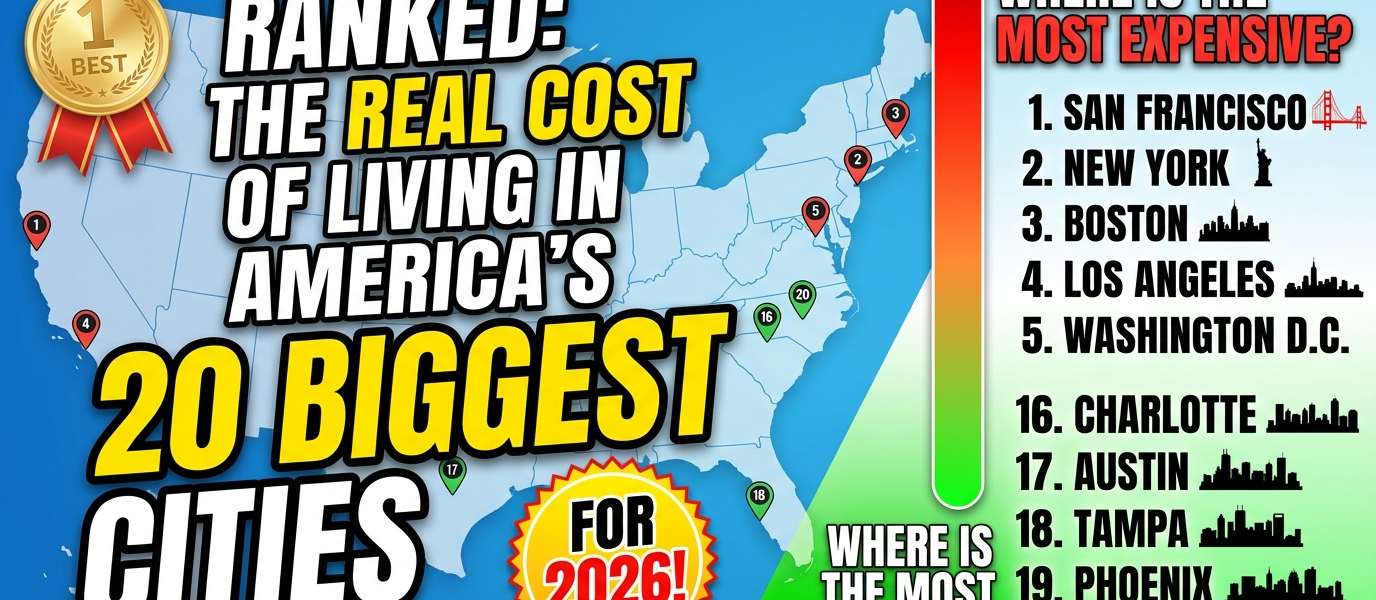
The Real Cost of Living in America’s 20 Biggest Cities — Ranked for 2026
Remote workers, job-seekers, and young families are all asking the same question: can I actually afford to live there? We ran the numbers on rent, groceries, taxes, childcare, and the hidden costs most ranking lists ignore.
The national conversation about affordability has fundamentally shifted. Two years ago, the debate was “should you leave New York?” Today it’s “is anywhere actually affordable anymore?” Rents that dropped briefly post-pandemic have roared back. Insurance costs have exploded in Sun Belt cities. Austin, once the darling of tech relocators, now costs more than Seattle did in 2018.
We analyzed 47 individual cost categories across all 20 cities — including state income tax, car insurance (which varies wildly by zip code), average utility bills, grocery costs, and the single most-ignored expense in most rankings: childcare, which in some cities exceeds rent for a one-bedroom apartment.
The headline: the salary you need to live comfortably varies by nearly 3× between the cheapest and most expensive cities on this list. Here’s the full breakdown.
- San Francisco remains the most expensive city despite a 6% rent decline — you need $127,000/yr to live comfortably as a single adult
- Detroit offers the lowest comfortable-living threshold at $44,500/yr — 65% less than San Francisco
- Austin is no longer a bargain: comfortable single living now requires $72,000/yr, up 41% since 2021
- Phoenix and San Antonio offer the best value for remote workers earning $60K–$75K
- Childcare in NYC, San Francisco, and Washington D.C. exceeds $2,800/month — more than a 1BR apartment in 12 U.S. cities
- Texas and Florida’s lack of income tax saves residents $4,000–$9,000/year vs. California and New York — but rising property taxes are closing the gap
The Full 2026 Rankings
“Comfortable living” = 1BR apartment, groceries, utilities, transportation, dining out twice a week, no debt, moderate savings. Figures are for a single adult unless noted.
| # | City | Salary needed | Avg 1BR rent | Cost index | Tag |
|---|---|---|---|---|---|
| 1 | San Francisco, CA SF-Oakland metro |
$127,000 | $3,180 | Most expensive | |
| 2 | New York City, NY Manhattan / outer boroughs |
$121,000 | $3,050 | Most expensive | |
| 3 | Boston, MA Greater Boston |
$108,000 | $2,870 | Very expensive | |
| 4 | Seattle, WA King County |
$104,000 | $2,640 | No income tax | |
| 5 | Washington, D.C. DC metro area |
$101,000 | $2,580 | Fed job hub | |
| 6 | Los Angeles, CA LA County |
$99,500 | $2,490 | High taxes | |
| 7 | Denver, CO Denver-Aurora |
$88,000 | $2,040 | Rising fast | |
| 8 | Austin, TX Travis County |
$72,000 | $1,780 | No longer cheap | |
| 9 | Chicago, IL Cook County |
$71,500 | $1,890 | Remote-friendly | |
| 10 | Nashville, TN Davidson County |
$70,000 | $1,740 | Fast growing | |
| 11 | Dallas, TX Dallas-Ft. Worth |
$65,500 | $1,620 | Remote hub | |
| 12 | Minneapolis, MN Hennepin County |
$63,000 | $1,530 | Underrated gem | |
| 13 | Charlotte, NC Mecklenburg County |
$61,000 | $1,470 | Great value | |
| 14 | Atlanta, GA Fulton County |
$60,500 | $1,510 | Remote-friendly | |
| 15 | Phoenix, AZ Maricopa County |
$59,000 | $1,430 | Best under $60K | |
| 16 | Philadelphia, PA Philly metro |
$57,500 | $1,560 | NE bargain | |
| 17 | Jacksonville, FL Duval County |
$52,000 | $1,320 | No income tax | |
| 18 | San Antonio, TX Bexar County |
$48,500 | $1,180 | Excellent value | |
| 19 | Memphis, TN Shelby County |
$46,000 | $1,050 | Most affordable | |
| 20 | Detroit, MI Wayne County |
$44,500 | $980 | Cheapest major city |
“The cities that were ‘affordable alternatives’ in 2021 are not the same cities in 2026. Austin, Nashville, and Denver have all crossed thresholds that price out median-income earners.”
— Analysis based on BLS Consumer Expenditure Survey, MIT Living Wage Calculator, and Zillow Rent Index 2026Deep Dive: Top 5 Most Expensive Cities
Monthly cost breakdown for a single adult living comfortably. All figures are 2026 estimates.
The Hidden Costs Most Rankings Ignore
These expenses can add $300–$2,800 per month to your actual cost of living — and almost no ranking list accounts for them.
Best Cities for Remote Workers Earning Under $60,000/Year
If you work remotely and your salary is $45K–$60K, these cities let you actually build savings — not just survive. Score = value index (lower salary required + quality of life + internet infrastructure).
-
San Antonio, TXStrong fiber coverage · No state tax · Growing tech scene$48,500 needed94
-
Phoenix, AZYear-round sun · Low income tax · Strong remote community$59,000 needed91
-
Charlotte, NCFast internet · Banking hub · Underrated food scene$61,000 needed89
-
Atlanta, GAHuge co-working network · Delta flights everywhere$60,500 needed88
-
Jacksonville, FLNo income tax · Beaches · Rapidly improving infrastructure$52,000 needed86
-
Minneapolis, MNBest internet speeds in midwest · Thriving arts scene$63,000 needed83
-
Memphis, TNCheapest rents on list · No state income tax$46,000 needed80
Is Austin Still Affordable in 2026?
The short answer: no — not by the standards that made it famous.
Austin’s median 1-bedroom rent has risen from $1,240 in 2020 to $1,780 in 2026 — a 43.5% increase in six years. Meanwhile, wages in the city’s dominant industries (tech, government, healthcare) have not kept pace for median earners. The average tech salary in Austin is still lower than in San Francisco or Seattle, but the cost gap has narrowed dramatically.
The specific costs that have shocked Austin newcomers since 2022 include property taxes (among the highest effective rates in the nation, hitting renters indirectly through pass-through costs), car insurance (required since the city is car-dependent, and Texas rates have risen sharply), and electricity bills, which spike dramatically in summer due to ERCOT grid pricing and heavy A/C use.
That said, Austin still beats San Francisco, New York, Seattle, and Denver on the comfort-threshold salary. It ranks #8 on our list — not the bargain it was, but not a trap either. If you’re earning above $80K remotely or in-person, Austin remains a solid choice over coastal cities.