
TrainingAICybersecurityRwanda
University of Kigali Opens Registration for AI and Cybersecurity Certification Programmes (From 16 November 2026)
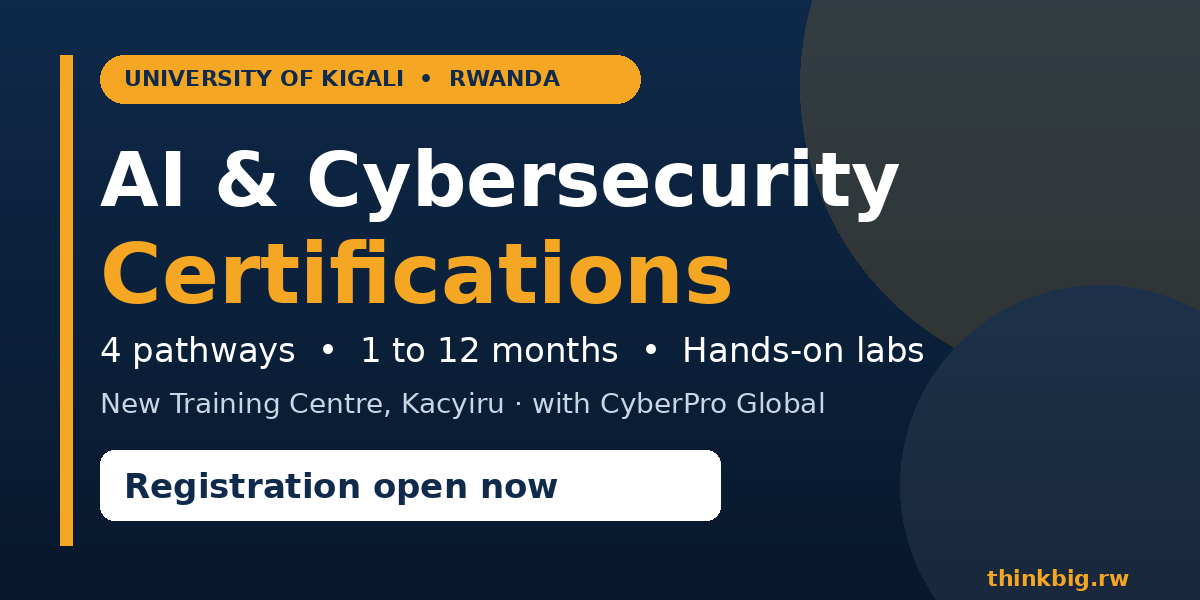
The University of Kigali (UoK) has opened registration for four certification pathways at its new AI and Cybersecurity Training Centre. The centre was launched on 6 November 2026 at the UoK Main Campus in Kacyiru, Kigali, in partnership with Kenya-based CyberPro Global. Registration opened on Monday, 16 November 2026.
Registration is open now for all four pathways, with an online form reached through the QR code on the programme flyer.
Programme Overview
| Institution | University of Kigali (UoK) |
|---|---|
| Centre | AI and Cybersecurity Training Centre, Main Campus, Kacyiru, Kigali |
| Partner | CyberPro Global (Kenya) |
| Pathways | 4 certification levels, from Foundation to Professional |
| Duration | From one month to 12 months, depending on the level |
| Training style | Hands-on labs, industry case studies, practical assignments and continuous assessment |
| Registration opened | 16 November 2026 |
The Four Certification Pathways
Foundation
Certificate in Cybersecurity and AI (CCAI)
1 month · 80 hours
Intermediate
Advanced Certificate in Cybersecurity and AI (ACCAI)
3 months · 240 hours
Advanced
Specialist Certificate in Cybersecurity and AI (SCCAI)
6 months · 480 hours
Professional
Professional Certificate in Cybersecurity and AI (PCCAI)
12 months · 720 hours
| Pathway | Who can join | Topics covered |
|---|---|---|
| Foundation (CCAI) | Completed Senior Six, currently pursuing a bachelor’s degree, or holding a bachelor’s degree in any field | Digital safety, phishing, networking fundamentals, responsible use of generative AI |
| Intermediate (ACCAI) | Completed the Foundation level, or pursuing an ICT or computer science degree at a recognised institution | Vulnerability assessment, incident response, cloud security, machine learning |
| Advanced (SCCAI) | Intermediate certification plus at least two years of relevant work experience | Penetration testing, digital forensics, threat intelligence, deep learning |
| Professional (PCCAI) | Entry requirements not specified. Contact the Centre | Security architecture, Zero Trust, large language models, enterprise AI governance |
How the Training Works
- Laboratory sessions, industry case studies, practical assignments and continuous assessment.
- Every pathway ends with an applied project.
- Assessment relies on hands-on lab work rather than only written exams, according to Dr. Wilson Musoni, Dean of the School of Computing and Information Technology and Centre Lead.
About the Centre
- The Centre opened with 50 workstations, and CyberPro Global has committed to expanding this to about 200.
- It plans customised training for public institutions, private companies and NGOs, and applied research with students, lecturers and industry.
- At the launch, Antoine Sebera, CEO of the Rwanda Information Society Authority (RISA), represented the Ministry of ICT and Innovation. He urged employers to offer internships and support student projects.
- The Centre follows UoK’s 2025 Labour Market Study of 5,923 participants. Dr. Musoni said 71 per cent of surveyed employers reported high demand for these skills, and 90.9 per cent of alumni preferred practical, hands-on learning.
How to Register
- Choose the pathway that matches your education and experience.
- Scan the QR code on the official programme flyer to open the online registration form.
- Complete the form. For the Professional pathway, contact the Centre first about entry requirements.
Fees and start dates: the article does not state fees or class start dates. Contact the Centre to confirm them before you register.
Contact
- Dr. Wilson Musoni (Centre Lead): +250 784 186 370 · wmusoni@uok.ac.rw
- General enquiries: info@uok.ac.rw
Source: The New Times. Details may change; confirm programmes, fees and dates with the University of Kigali before registering.