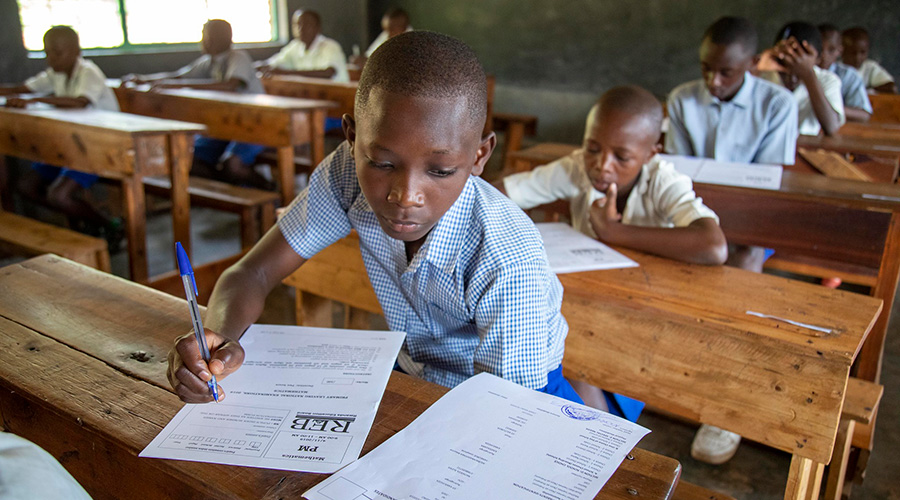
P6 Leaving Examination — English Test 11 2021

Primary Leaving National Examinations

English  |  P6  |  2021  |  Total: 100 marks  |  Duration: 2 hours
📝 Student Details
Section A: Composition Writing (20 marks)
Choose ONE topic and write a composition of about 100 words. (20 marks)
Write your composition below. After submission, a self-assessment guide will appear.
1 Write a letter to a friend in another country describing your family members.
0 / 100 words
2 Write a description of a friend you like most in your class and reasons why you like that person.
0 / 100 words
3 Write a story with the title “My best holiday”.
0 / 100 words
Section B: Grammar (30 marks)
Part One: Choose the best answer (A, B or C) to complete the sentences. (10 marks)
1 The boy ____________ his head on the door last night while playing.
2 Keza _____________ her foot when she knocked a stone.
3 The window _____________ by the students who were playing football.
4 I am tired _____________ singing the same song every day.
5 _________________ you lifted this bag with one hand.
6 There will be a match _____________ our school and another neighbouring one.
7 _____________ pupils and _____________ old man were walking when a motorcycle almost knocked them.
8 If you _____________, you will pass this exam excellently.
9 Ngoga has a sister _____________ plays football better than all boys in our school.
10 Ms. Rose is _____________ teacher of English in our school.
Part Two: Fill in the blank spaces with the correct pronouns. (5 marks)
Type the correct pronoun (he, she, it, we, they, him, her, them, you…) in each box.
1 Peter and I are brothers. share a bedroom.
2 Sugira isn’t well. Dad is taking to see a doctor.
3 My brother is a teacher. teaches English.
4 All his students like very much.
5 Children, are making too much noise!
Part Three: Write a, an or the in the blanks to complete the sentences. (5 marks)
Type a, an, or the in each gap. Separate two answers with a comma (e.g. a, the).
1 There is rainbow in sky.
2 Who is man outside gate?
3 doctor gave Jane injection.
4 Paul opened door to let dog in.
5 Mark is only child in family.
Part Four: Fill the blanks with the correct prepositions from the box. (10 marks)
near  |  by  |  on  |  at  |  between  |  in  |  around  |  into  |  up  |  behind
1 The bus arrived exactly 8:30 A.M in the morning to take me from the school.
2 The children are swimming the pool with their trainer.
3 There’s a picture of our class party the wall.
4 There is a fence the house where my friend Teta lives.
5 My mother is sitting the fire telling us stories about the past.
6 The pupil was hiding the chair when they were playing hide and seek.
7 The monkey climbed the mango tree and ate our mangoes.
8 We divided the maize the two of us and got the same size.
9 I jumped the river when my friends were chasing me.
10 Don’t go the edge of the building. You will fall down.
Section C: Vocabulary (20 marks)
Part One: Write the noun that is spelled correctly in each row. (5 marks)
Choose which word is spelled correctly from the three options and type it in the box.
Part Two: Identify and type the adjective in each sentence. (6 marks)
Read each sentence and type the adjective in the box provided.
Part Three: Write the plural form of each singular noun. (9 marks)
Section D: Comprehension (20 marks)
Read the passage below carefully, then answer all questions.

Before people started writing, they told stories orally; many good stories were not recorded. They finally disappeared. Others were changed and are not original anymore. These kinds of stories told by word of mouth are called oral traditional stories.

Since writing started, books have played an important part in people’s life. In books we learn about cultures of other people, we interact with characters and compare ourselves with them. We also learn vocabulary and get entertained. The writing of stories came to solve the problems of oral stories.

Today, children in Rwanda are becoming more interested in reading books. This is because many people are writing very nice stories. Parents have also known the importance of reading. Also, many non-government organisations are encouraging people to write children stories.

Many stories in children’s books are about animals. These are called fables. Animal stories helped children to learn moral lessons from them in funny ways. Many Rwandan children animal stories talk about how animals live together. They also talk about behaviours of those animals with each other. In those stories, animals can talk, support each other and do kind acts to others. Sometimes, animals challenge each other and finally learn a lesson. Common stories are the hare stories.

Children also love stories called fairy tales. These stories entertain children. Children are very happy to read about people flying from heaven to the earth, insects being used as transport, birds attending parties in heaven etc. These kinds of stories present a world where everything is possible and life is very interesting, scaring and peaceful.

Generally, stories are important for children. They help children to know about the past. Children learn moral lessons and also get entertained. Parents should encourage their children to read and support them by buying books for them.


Part One: Answer True or False. (6 marks)
1 Long ago people did not know how to read and write.
2 Children don’t love stories.
3 Many stories from the past are still original.
4 Stories about animals talk about how animals live.
5 In fairy tales, people can fly.
6 Stories don’t add any value to children.
Part Two: Answer these questions in full sentences. (14 marks)
Type your answer in full sentences. Model answers will appear after submission.

🎓 Your Result

0
out of 100

Leave a Reply

Your email address will not be published. Required fields are marked *